Donkey Development Kit
Governed by the gateway. Understood by your code. DDK brings Omni Gateway awareness into the agents you already write — in LangGraph, Google ADK, Strands, CrewAI, LlamaIndex, the OpenAI Agents SDK, the Anthropic SDK or Microsoft Agent Framework — so governance is not just enforced on your agents, it is respected by them.
Why gateway awareness
Enterprises put a gateway in front of their AI traffic for good reasons: one place to authenticate every caller, meter every token, block personal data, stop prompt injection and attribute cost to the team that spent it. MuleSoft Omni Gateway, managed through Agent Fabric, does exactly that — for LLMs, MCP servers, APIs and agents alike.
But a gateway that governs alone only solves half the problem. The agent on the
other side of the wire sees an opaque 403 or 429 and does what code does
with errors it does not understand: it retries a PII block as if it were a
network blip, burns the remaining budget on calls that will be refused, crashes
a nightly batch at 2am, and leaves no trace that connects its own run to the
gateway’s audit log. Control is one-sided, and the cost of that shows up as
wasted tokens, broken runs and incident tickets.
DDK makes governance a collaboration. It brings the gateway’s view of the world into your agent code:
- a PII refusal arrives as a typed
PIIDetected, not a generic HTTP error, so the agent can redact and continue instead of retrying; - the remaining token budget is an object the agent can pace against, instead of a limit it discovers by failing;
- every call carries a correlation ID and cost tags, and emits an OpenTelemetry span that lines up with the gateway’s own audit trail;
- and you can rehearse all of it on your laptop, against a local simulator, before an agent ever meets production policy.
The gateway stays the enforcement point — it always has the final word. What changes is that your agents become good citizens of the platform: aware of the rules, efficient within them, and observable end to end. That is the enterprise vision behind DDK — control at the proxy, efficiency in the agent — built for AI engineers, developers and the AI teams who have to run their agents in production.
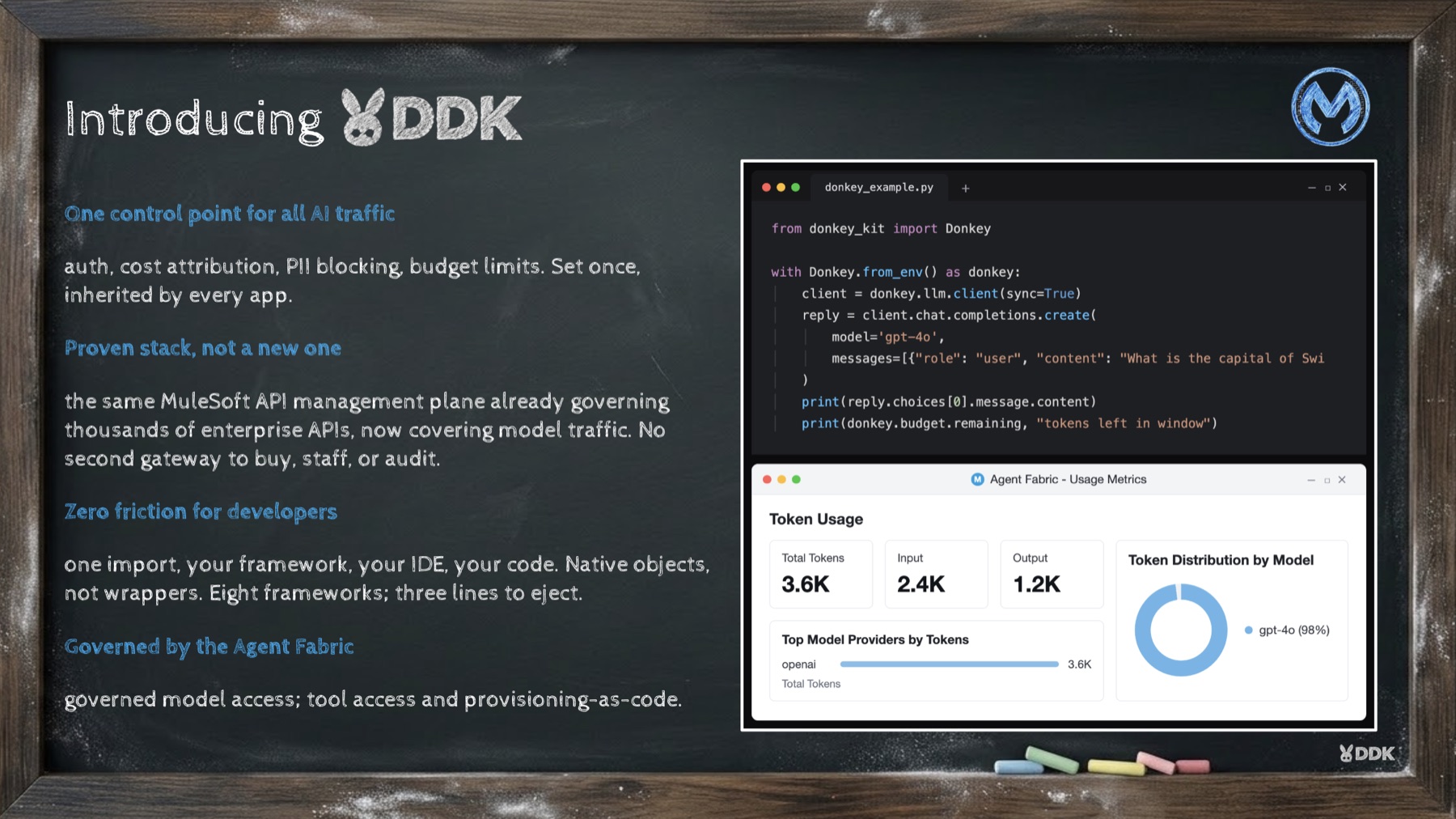
Authentication, cost attribution, PII blocking and budget limits are set once at the gateway and inherited by every app that uses DDK.
The same MuleSoft API management plane that already governs thousands of enterprise APIs, now covering model traffic. No second gateway to buy, staff or audit.
One import, your framework, your IDE, your code. DDK returns native framework objects, not wrappers — eight frameworks, three lines to eject.
Governed model access today, with governed tool access, agent-to-agent calls and publishing to the Agent Fabric registry on the same foundation.
DDK is an open-source, community-driven project (Apache-2.0). It is not an official Salesforce or MuleSoft product and is not supported by Salesforce. “Agent Fabric”, “Anypoint”, “MuleSoft” and “Omni Gateway” are Salesforce trademarks; DDK uses them only to describe the platform it connects to. Meet the people behind it on the Team page.
Architecture
DDK sits inside your agent process and speaks to the platform on three fronts: governed calls through the gateway, assets published to the control plane, and telemetry to your observability stack.
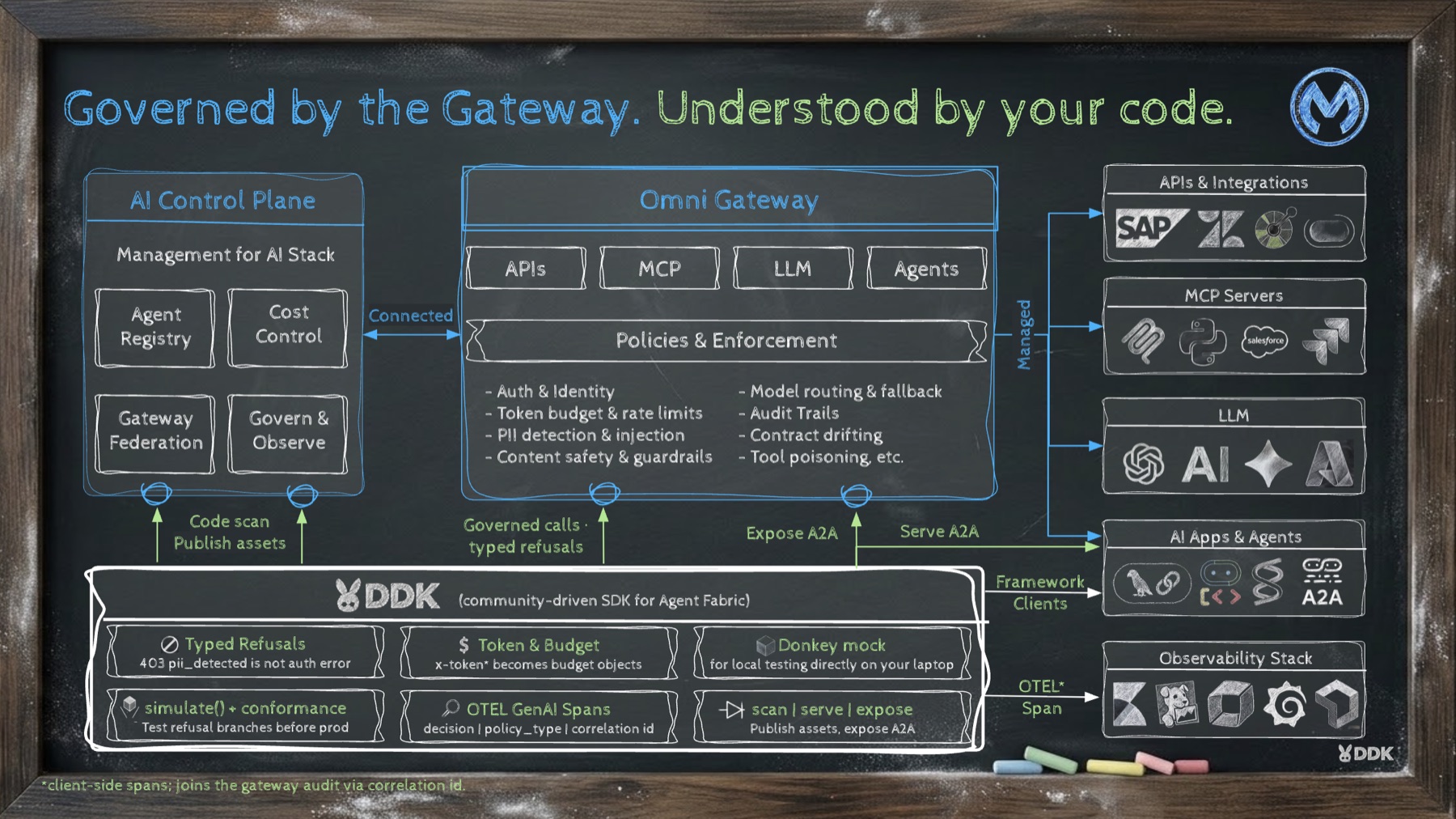
The AI control plane is where the platform team manages the AI estate: the agent registry, cost control, gateway federation, and governance and observability across every runtime.
Omni Gateway is the single data-plane entry point for APIs, MCP servers, LLMs and agents. Its policies do the enforcing — authentication and identity, token budgets and rate limits, PII detection, prompt-injection and content-safety guardrails, model routing and fallback, audit trails, contract drift and tool-poisoning detection — before traffic reaches the managed upstreams: enterprise APIs and integrations, MCP servers, LLM providers, and other AI apps and agents.
DDK is the developer-side half of that picture. It is wired into the framework client your agent already uses and adds:
- Governed calls and typed refusals — every model request goes through the
gateway with consumer credentials, correlation and attribution headers
injected; every policy rejection comes back as a typed exception such as
PIIDetectedorTokenBudgetExceeded, never confused with an auth error. - Token budget awareness — the gateway’s rate-limit headers become a
Budgetobject withremaining,pace()andwait_for_reset(). - Local testing —
donkey mockanddonkey.simulate()replay real gateway rejection shapes on your laptop, and a pytest conformance suite proves your agent handles each one before it ships. - OpenTelemetry GenAI spans — each call emits a span carrying the policy decision, policy type, budget and correlation ID, exported to whatever observability stack you run (Grafana, Datadog, Jaeger, and others) and joined to the gateway’s audit record through the correlation ID.
- Registry and agent-to-agent — scanning your code to publish tools and agent cards to the control plane, and serving or exposing your agent to other agents over A2A.
The division of labour is deliberate. The gateway enforces; DDK makes the enforcement legible and actionable inside the agent. Nothing in DDK re-implements a policy client-side, and nothing in your process can override the gateway.
Before and after
Take the most ordinary piece of agent code there is: one model call.
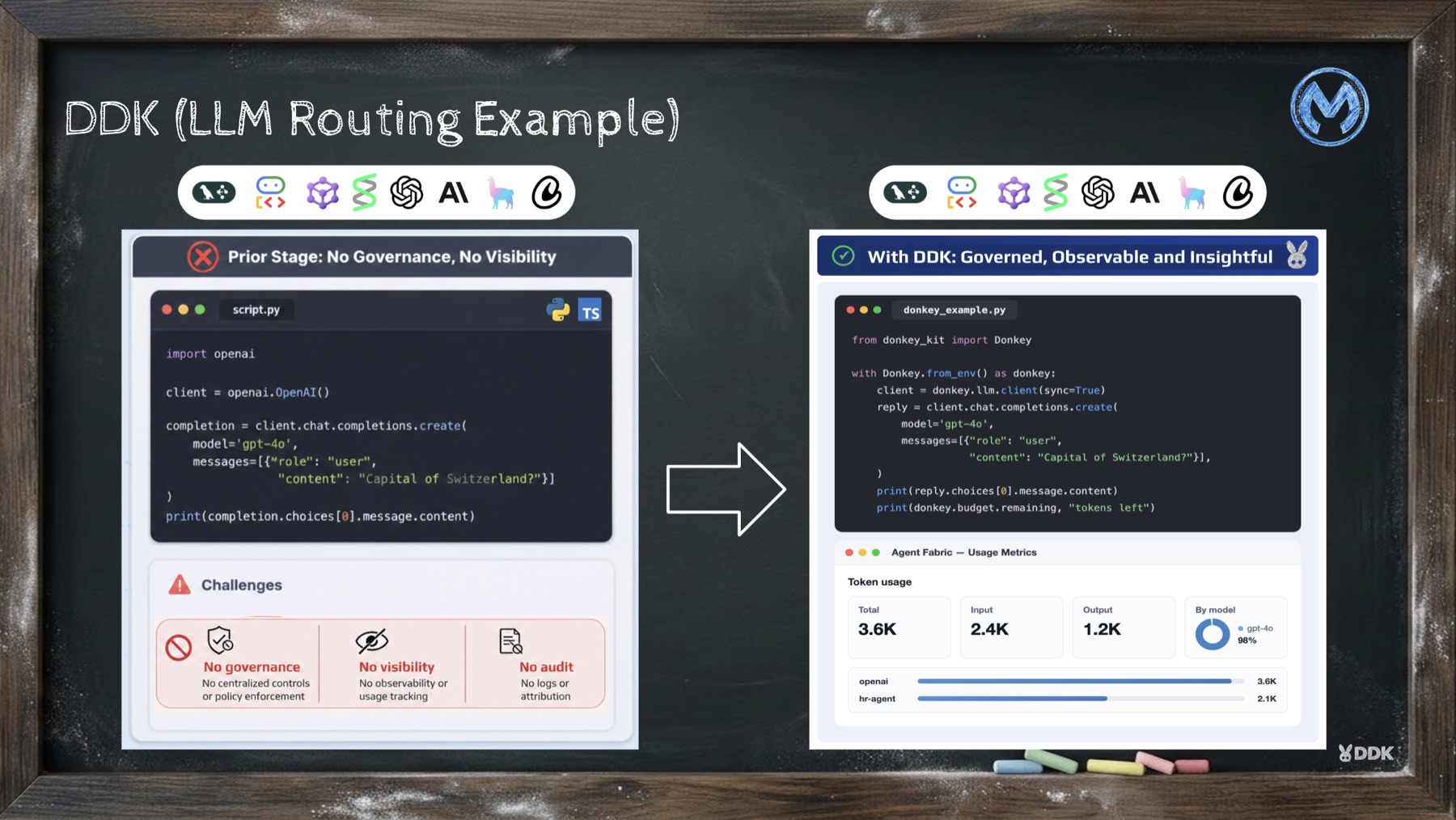
Without DDK, a stock client talks straight to the model provider. It works — and it is invisible. There are no centralised controls or policy enforcement, no usage tracking, no record of which team or agent spent which tokens, and nothing an auditor can follow.
import openai

client = openai.OpenAI()
completion = client.chat.completions.create(
    model="gpt-4o",
    messages=[{"role": "user", "content": "Capital of Switzerland?"}],
)
print(completion.choices[0].message.content)
With DDK, the call is the same shape and the client is the same native
openai.OpenAI — but it now goes through your organisation’s Omni Gateway.
The request is authenticated and attributed, policy is applied, the agent
knows how much budget it has left, and the platform team sees the usage per
model and per consumer in Agent Fabric.
from donkey_kit import Donkey

with Donkey.from_env() as donkey:
    client = donkey.llm.client(sync=True)      # a real openai.OpenAI, governed
    reply = client.chat.completions.create(
        model="gpt-4o",
        messages=[{"role": "user", "content": "Capital of Switzerland?"}],
    )
    print(reply.choices[0].message.content)
    print(donkey.budget.remaining, "tokens left")
Three lines changed. Governed, observable and attributed — without leaving your framework.
Make a governed call
From Python, DDK hands you your framework’s own objects. From any other
language, call the same governed proxy over its OpenAI-compatible HTTP API
with the client_id / client_secret header pair.
Python (async)
from donkey_kit.integrations.langgraph import chat_model

# A real langchain_openai.ChatOpenAI, already pointed at your governed proxy.
model = chat_model("gpt-4o", temperature=0)
reply = await model.ainvoke([("user", "Explain quantum computing in simple terms.")])
print(reply.content)Native objects, never wrappers
Adapters return the framework’s native object — never a wrapper.
donkey.langgraph.chat_model("gpt-4o") returns a real langchain_openai.ChatOpenAI.
donkey.llamaindex.llm("gpt-4o") returns a real OpenAILike. Hand them
straight to create_agent, a LlamaIndex query engine or a Strands Agent.
And if you ever want to drop DDK, you eject to three lines of native
constructor code — every framework page shows exactly which
three.
A stock client with a base_url and two headers can reach the gateway. What
DDK adds is the single place in your process where every request enters
and every response leaves — which is where typed refusals, budget pacing,
correlation IDs, cost tags, spans and simulation all attach without you
wiring each one.
Next steps
Your first governed call in minutes — no gateway or credentials needed.
Feature overviewEvery capability, its purpose, and what it saves you.
FrameworksInstall and quickstart for each of the eight supported frameworks.
ExamplesRunnable demos, from a first governed call to a full LangGraph agent.
RoadmapWhat is available now and what is coming next, phase by phase.
ContributeDDK is open source — issues, docs, examples and adapters welcome.